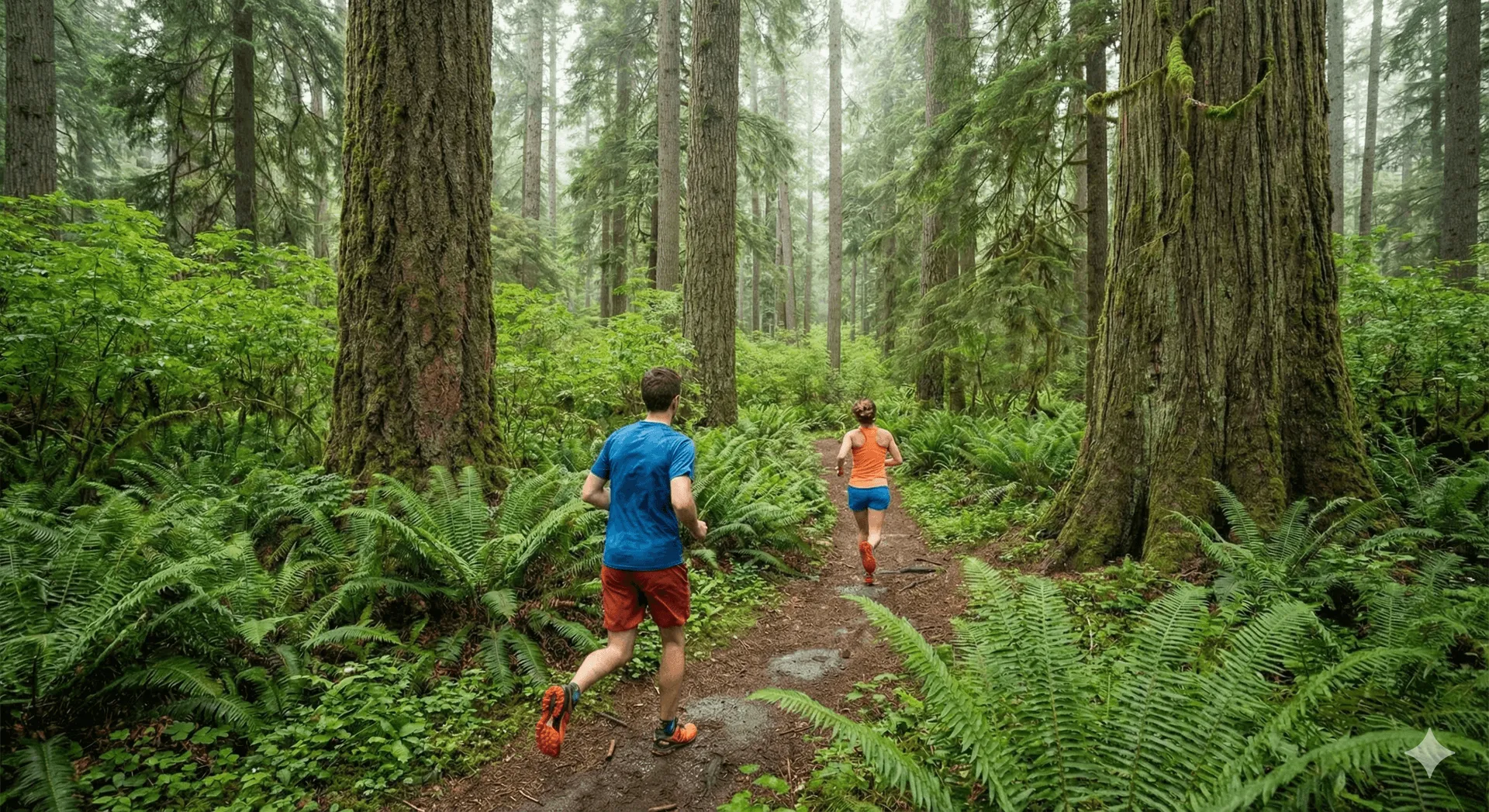
In March 2025, I laced up my running shoes with an audacious plan forming in the back of my mind: 12 ultramarathons in 12 months. The problem? I hadn’t properly run in 15 years.
The gap wasn’t voluntary. I used to love running—ran several times a week in university, sometimes even after football practice because I still had the urge. But a knee injury in 2009 ended that. I couldn’t run more than a few hundred meters without pain. Eventually I gave up and moved to other sports. When I stopped running, something inside me died.
Then in 2025, while recovering from an overuse hiking injury, I realized the knee pain had disappeared. My physio inspired me to try running again. And when I could—when I was actually running again—I felt energized in a way I’d forgotten was possible. Running is meditation. It’s also the purest form of challenge: a pair of shoes, and then it’s just you against yourself. No technology, no mechanics like a bike. Just the simple motion of putting one foot in front of the other. Compared to hiking, where you eventually cap out, running lets you test yourself—against yesterday’s version, against last year’s version. Get out into nature and push both the physical and mental limits. That’s why I run.
That first week back was humbling. I couldn’t run a full kilometer continuously without my heart rate spiking and my form collapsing. So I did what I had to: run a minute, walk a few minutes, repeat.
Eight months later, the numbers told a clear story. I had run 1,800 km and reduced the cardiac cost—the number of heartbeats required to run a given distance—by 32.3%. On comparable terrain, I was covering each kilometer 25% faster but with roughly one-third fewer heartbeats. What had felt unsustainably hard in the spring became repeatable, controlled, and scalable by winter.
This article is a breakdown of how that happened—quantitatively, deliberately, and sometimes painfully—and why this year wasn’t the destination, but the minimum required foundation for what comes next.
From Run-Walk to Believing This Was Possible
The early phase wasn’t about performance. It was about belief.
At first, I couldn’t run a full kilometer continuously. Then I could run one. Then two. Then three. Then five. Each milestone felt trivial on paper and massive in practice. The biggest shift wasn’t physical—it was realizing that progress was happening even when it felt slow.
That belief changed my behavior.
Once I could string together longer efforts, I started looking for something concrete to train towards. That’s when I noticed local trail races and decided to sign up for one—about three weeks out—mostly for motivation and to test myself.
That first race was brutal. I went out far too hard, blew up completely, and walked large portions of the final kilometers. But it was also fun in a way that regular training runs weren’t. It was focused. It mattered. And when it was over, instead of feeling discouraged, I felt hooked.
I immediately signed up for another one.
Over the next seven months, I ran six more races. Those races became fixed reference points—honest, all-out efforts that made progress (or the lack of it) impossible to hide.
Measuring Progress Race by Race
One of the most useful things I did this year was treat races as checkpoints, not outcomes. Because races are maximal or near-maximal efforts, they’re excellent for comparison.
Between my first race and my last:
- Grade Adjusted Pace (GAP) times improved meaningfully
- Average heart rate at similar effort levels dropped
- Late-race fade decreased or disappeared entirely
- Performance became more even across the full distance
The most important insight wasn’t that I got faster. It was where I was losing time and why. That led directly into the next major shift.
Learning How to Pace (and Stop Blowing Up)
In my first race, I paid the price for enthusiasm. I ran the early kilometers as if fitness were unlimited and paid for it brutally at the end. The second race was slightly better—but not by much.
That’s when I started using AI more deliberately. I fired up ChatGPT and fed in course maps and elevation profiles from upcoming races, detailed information from my previous races, and recent running history. I asked what I was doing wrong and how I should approach the next race. The answer was clear: I was going out too hard relative to the course difficulty and my fitness, burning matches I couldn’t afford.
For the third race, I tried something new. I asked AI to help build a pacing plan before the race—adjusting effort targets based on terrain, elevation, and expected fatigue.
The difference was immediate. I didn’t blow up. I finished stronger than I started. And for the first time, the last kilometers weren’t a survival exercise—I ended with energy left in the tank.
From that point on, every race had a pacing plan. Not rigid splits—but guardrails. This helped me gain vital race experience much faster.
Fueling: The Second Half of the Equation
Pacing and race strategy solved one problem. Fueling solved another. Even with better pacing, I noticed energy levels dipping late in longer efforts. The issue wasn’t mysterious—I simply wasn’t taking in the right amount of fuel or fluids.
So I started tracking it. When I fueled, how much I fueled, what I fueled, and how that correlated with late-race performance. I did this on every single trail run. Fueling became deliberate instead of ad-hoc.
On a typical 40 km trail run, my fueling protocol looks like this: I carry water mixed with Tailwind carbohydrate powder, and I take in calories every 30 minutes for the duration of the effort. Over six hours, that means twelve fueling windows—each one planned, each one executed. The consistency matters. Miss one window and the deficit compounds. Hit every window and the last hour feels nearly as strong as the first.
This systematic approach transformed longer runs from exercises in survival to controlled, repeatable efforts.
Navigating Injuries: The Hidden Tax of Coming Back
The numbers from 2025 tell a story of steady progress. But behind those numbers was a more complicated reality: my body was learning to run again, and it didn’t always cooperate.
The biggest issue was my left knee. What started as occasional ITB discomfort in June became a chronic problem by August. There were runs I had to abort mid-effort, races where the pain started right out of the gate, and training weeks I had to scale back entirely. For six months, that knee was the limiting factor—not my cardiovascular fitness, not my motivation, but whether my ITB would hold up for the distance.
I tried to manage it intelligently. Rest days when needed. Reduced volume when the warning signs appeared. But I also learned the hard way that ignoring early signals led to bigger problems. In August, I sprained my ankle on a trail descent—my first sprain in a decade. It forced five days completely off running, and when I came back, I was cautious about re-injury for weeks.
The pattern was clear: push too hard, too fast, and my body pushed back. There were multiple stretches where I was, in my own words, “walking a fine line between growth and injury.” Some weeks I walked that line successfully. Other weeks I crossed it.
Beyond the mechanical issues, illness disrupted training three separate times. The worst came in late December—a respiratory infection that knocked me out for a full week. My overnight resting heart rate spiked 25%, HRV dropped 30% from baseline, and for seven days I did nothing. It was the worst I’d felt in 15 months, and a stark reminder that you can’t train through everything.
The lesson wasn’t that injuries are avoidable—they’re probably not, especially when rebuilding from scratch. The lesson was that progress isn’t linear. There are setbacks, adjustments, and weeks where the best training decision is to not train at all. The 1,800 kilometers I ran this year weren’t just the sum of good days. They were also the result of managing bad days well enough to keep moving forward.
Closing: The Year That Built the Foundation
The past eight months have been transformative—not just in the fact that I can run again, but in the results and how I approach the sport.
The biggest change wasn’t some magic workout. I treated the year like an ongoing experiment: observe, adjust, test again. That mindset—and the data behind it—is what turned “getting back into running” into something that actually looked like progress.
But as big as this year feels, it’s not the finish line. If anything, it’s only the first split on a long journey.
The goal for 2026 is deliberately audacious: 12 ultramarathons in 12 months. That isn’t something you can bluff your way through, especially coming off a 15-year running hiatus. It will require more volume, more durability, and a sharper approach to everything that mattered this year: training structure, recovery, pacing, fueling, and the analytics to keep it all honest. I want to see how far I can take it.
I’ll keep documenting the journey here: how I’m training, what I’m learning, what breaks, what works, and what the numbers say when the goal is no longer “get back into shape,” but “become the best endurance runner I can be.”